

Full-size luxury SUVs are where automakers stop compromising — and where two very different definitions of "flagship" collide.
The INFINITI QX80 and the BMW X7 sit at the top of their respective lineups, and both promise the same headline package: three rows of seating, real towing capability, and a cabin built to make a two-hour drive across the Valley feel like fifteen minutes. Look past the shared brief, though, and these two SUVs are engineered around opposite instincts. The QX80 is a body-on-frame flagship built to haul people, gear, and trailers with authority. The X7 is a unibody grand tourer that happens to seat seven. If you want to see the differences up close, our team keeps a broad selection of trims on the ground in Mesa — start by exploring the 2026 INFINITI QX80 interior and its lounge-style second and third rows.
That distinction matters more than any single horsepower figure. A buyer who tows a boat to Roosevelt Lake every other weekend, carries five or six passengers regularly, and wants a third row adults will actually volunteer for has different needs than a buyer whose priority is carving up the 101 on the way to dinner. Cross-shopping beyond the German brands? Our INFINITI QX80 vs Nissan Armada comparison tackles the platform-mate question head-on.
Below we work through powertrains, interior space and materials, technology, safety credentials, and the full cost of ownership — using 2026 model-year figures and published test results rather than marketing language. The goal is simple: give you enough accurate detail that when you walk into our Mesa showroom, you already know which questions matter most for your driveway.
Key Takeaways
- The 2026 QX80 makes 450 horsepower and 516 lb-ft from a standard twin-turbo V6 — 75 more horsepower and 118 more lb-ft than the BMW X7 xDrive40i, which starts at a similar price
- The QX80 tows up to 8,500 pounds properly equipped, versus a 7,500-pound maximum for the X7 — a meaningful gap for boat, camper, and toy-hauler owners
- Cargo room isn't close: 22.0 cubic feet behind the QX80's third row and 101.3 cubic feet maximum, compared with 12.8 and 90.4 cubic feet in the X7
- The QX80 seats up to eight passengers; the X7 tops out at seven, and six when equipped with second-row captain's chairs
- The 2026 QX80 is an IIHS TOP SAFETY PICK with "Good" ratings across every crashworthiness test performed — the BMW X7 has no published IIHS or NHTSA crash ratings
- INFINITI backs the QX80 with a 6-year/70,000-mile powertrain warranty against BMW's 4-year/50,000-mile coverage, and routine parts and service cost measurably less over five years
- Coulter INFINITI in Mesa, Arizona offers no-pressure test drives and honest cross-shopping guidance for Greater Phoenix buyers
Comparing Two Full-Size Luxury Flagships
The full-size luxury SUV class is small, expensive, and unusually revealing about what a brand believes a flagship should be. There is no room to hide here — buyers spending six figures ask hard questions about third-row usability, towing ratings, seat comfort on a four-hour drive, and what the vehicle costs to keep on the road after the warranty lapses.
The INFINITI QX80 and BMW X7 answer those questions from opposite engineering starting points. The QX80 rides on a body-on-frame architecture with a fully boxed ladder frame — the same fundamental approach used by the Escalade, Navigator, and Wagoneer — which is why it tows more, sits taller, and delivers that planted, imperturbable ride full-size buyers associate with a proper big SUV. The X7 uses BMW's unibody CLAR platform shared with the X5, which is why it drives smaller than its footprint and feels more agile on a winding road, but also why its cargo hold and towing ceiling are noticeably tighter.
Here is how the priorities that actually drive purchase decisions in this segment break down:
| Decision Factor | Buyer Priority Level | Key Considerations |
|---|---|---|
| Third-Row and Cargo Usability | Very High | Adult-friendly seating, cargo behind row three, load floor height |
| Towing Capability | High | Maximum rating, trailer camera systems, sway control |
| Powertrain Output | High | Standard horsepower and torque, transmission behavior, drive modes |
| Total Cost of Ownership | Very High | MSRP, standard content, maintenance, parts pricing, warranty length |
| Cabin Materials and Technology | Very High | Screen quality, audio, seat comfort, driver-assistance depth |
Neither approach is objectively superior — they simply serve different owners. If the vehicle spends its life carrying two adults with occasional rear-seat guests and you value steering feel above all, the X7 makes a strong case. If it functions as the family's primary hauler, tow vehicle, and road-trip machine, the QX80's architecture is working in your favor every single day.
INFINITI QX80 Overview
The current QX80 arrived as a ground-up redesign, and it addressed nearly every criticism leveled at the previous generation. The aging naturally aspirated V8 gave way to a twin-turbocharged V6 with more power and far more torque, the seven-speed automatic was replaced by a nine-speed, and the cabin was rebuilt around a modern dual-screen architecture. The result is a flagship that finally competes on technology as convincingly as it always did on presence.
Design Philosophy and Market Position
INFINITI describes the QX80's design language as "Artistry in Motion," and in practice that means a vehicle with commanding proportions softened by careful detail work — the digital piano-key grille, the slim signature lighting, and a roofline that stays high and square rather than tapering for style points. That last decision is deliberate and consequential: keeping the roof flat is what preserves third-row headroom and cargo height. The QX80 targets buyers who want the substance of a full-size SUV with a design identity distinct from the Escalade-and-Navigator establishment, and it undercuts most rivals on the window sticker while matching or beating them on standard content. For business owners, the QX80's weight class also carries tax implications worth understanding — see our guide to which INFINITI SUVs qualify for the 6,000-pound tax write-off.
Key Specifications at a Glance
The QX80's numbers make its priorities obvious:
- Engine: 3.5-liter twin-turbocharged V6
- Power Output: 450 horsepower at 5,600 rpm
- Torque: 516 lb-ft at 3,600 rpm
- Transmission: 9-speed automatic
- Drivetrain: Rear-wheel drive standard, available All-Mode 4WD
- Fuel Economy: EPA-estimated 16 city / 19 highway mpg (4WD); up to 18 mpg combined
- Towing Capacity: Up to 8,500 pounds when properly equipped
- Seating Capacity: 7 or 8 passengers across three rows
- Cargo Space: 22.0 cubic feet behind the third row; 59.0 behind the second; 101.3 cubic feet maximum
Standard 450 Horsepower
Every QX80 — including the entry PURE — gets the full 450-hp twin-turbo V6. There is no downgraded base engine and no upcharge to unlock the good one
8,500-Pound Tow Rating
A full 1,000 pounds more than the X7, backed by Trailer Sway Control, Trailer Blind Spot Warning, and a Rear Zoom View camera that makes hitching a one-person job
Eight-Passenger Capability
Choose the second-row bench and the QX80 carries eight. The X7 cannot match that in any configuration — its ceiling is seven
Physically, the QX80 measures 211.2 inches long, 92.5 inches wide including mirrors, and 76.6 inches tall on a 121.1-inch wheelbase. Available electronic air suspension lowers the body for easier entry and raises it for ground clearance, while the Dynamic Digital Suspension on upper trims uses hydraulic body motion control to keep a 6,000-pound SUV remarkably flat through corners. Trims run from PURE (around $89,000) through LUXE and SPORT to the flagship AUTOGRAPH at roughly $113,700. If you're planning to put that tow rating to work, our 2026 QX80 towing capacity guide walks through hitch setup, payload math, and what the rating means in Arizona heat.
BMW X7 Overview
BMW came late to the full-size luxury SUV party, launching the X7 in 2019 as the brand's first genuine three-row SUV. What it lacked in segment history it made up for in execution: the X7 drives like a smaller vehicle, rides on air suspension as standard, and offers the most polished powertrains in BMW's SUV catalog. A mid-cycle refresh brought split headlight styling, mild-hybrid assistance for both engines, and the brand's curved display architecture.
Design Philosophy and Market Position
The X7 exists to prove that "Ultimate Driving Machine" scales up. BMW's engineers prioritized body control, steering response, and powertrain refinement over maximum interior volume, and the trade-offs show up in the spec sheet: a slightly shorter overall length than the QX80 despite a longer wheelbase, a lower roof, and a cargo hold sized for luggage rather than lumber. Standard two-axle air suspension and available rear-axle steering give the X7 a genuine dynamic edge that no body-on-frame competitor can replicate. Its buyer is typically someone stepping up from an X5 who needs occasional third-row capacity and refuses to give up the way a BMW turns in.
Key Specifications at a Glance
BMW keeps the X7 lineup simple — one six-cylinder, one V8, both with 48-volt mild-hybrid assistance and xDrive all-wheel drive:
| Specification Category | BMW X7 xDrive40i | BMW X7 M60i |
|---|---|---|
| Engine Type | 3.0L Turbo Inline-6, 48V mild hybrid | 4.4L Twin-Turbo V8, 48V mild hybrid |
| Horsepower | 375 hp | 523 hp |
| Torque | 398 lb-ft | 553 lb-ft |
| Drivetrain | xDrive All-Wheel Drive | xDrive All-Wheel Drive |
| 0-60 mph | 5.6 seconds | 4.5 seconds |
The X7 measures 203.6 inches long, 78.7 inches wide excluding mirrors, and 72.2 inches tall on a 122.2-inch wheelbase — shorter and more than four inches lower than the QX80. Cargo volume runs 12.8 cubic feet behind the third row, 48.6 behind the second, and 90.4 cubic feet with both rear rows folded. Maximum towing is 7,500 pounds. Pricing opens around $87,500 for the xDrive40i and climbs to roughly $115,000 for the M60i, and BMW's à la carte approach means options such as the Bowers & Wilkins audio system, rear-seat entertainment, Executive package, and rear-axle steering add several thousand dollars each before you reach a fully equipped example.
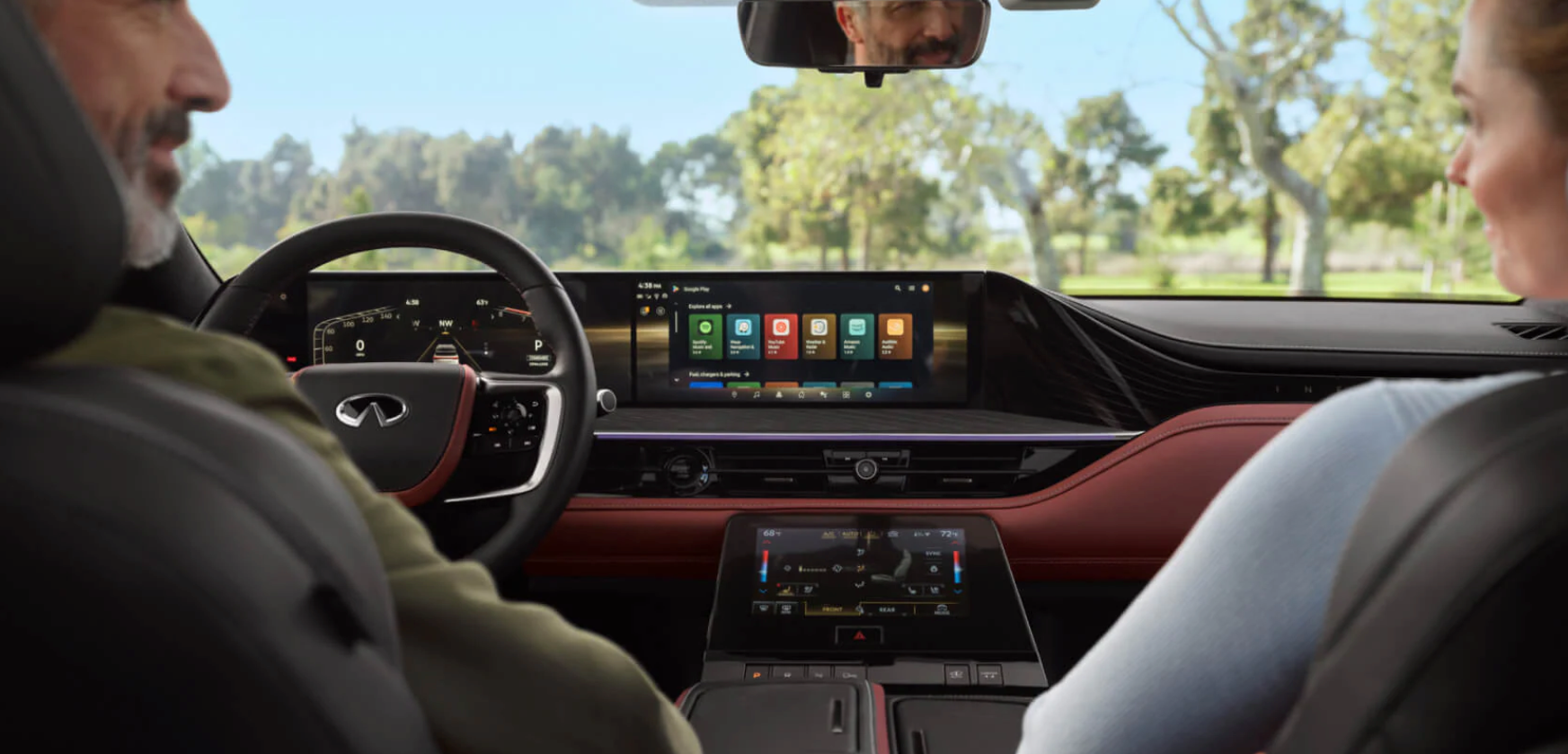
The 2026 INFINITI QX80 delivers 450 horsepower as standard equipment, an 8,500-pound tow rating, and three rows sized for adults — capability the BMW X7 asks you to pay extra for or simply cannot match
Performance and Powertrain Comparison
On paper this looks like a straightforward horsepower argument. In practice, the two SUVs feel different in ways the numbers only partly explain — one is engineered to move mass effortlessly, the other to disguise it.
INFINITI QX80 Performance
The QX80's 3.5-liter twin-turbo V6 produces 450 horsepower and 516 lb-ft of torque, with peak twist arriving at 3,600 rpm and a broad, flat delivery curve on either side of it. That torque figure is the real story: it is 118 lb-ft more than the X7 xDrive40i, and it is what allows a 6,000-pound SUV to merge onto Loop 202 traffic without drama or downshift hunting. The nine-speed automatic is calibrated for smoothness first, holding gears through part-throttle inputs rather than shuffling, and it pairs with an available All-Mode 4WD system offering Standard, Personal, Eco, Sport, Snow, and Tow drive modes.
Ride quality is where the QX80 quietly outperforms expectations. The available electronic air suspension keeps the body level regardless of load — meaningful when the third row is full and the cargo area is packed — and the Dynamic Digital Suspension on SPORT and AUTOGRAPH uses hydraulically linked dampers to counteract body roll without the harshness that stiff springs would introduce. Over Phoenix-area expansion joints and broken pavement, the QX80 absorbs impacts with a settled composure that lighter unibody SUVs struggle to replicate. Steering is light and low-effort by design, which makes a vehicle this size genuinely easy to park with the 3D Around View Monitor doing the spatial work for you.
BMW X7 Performance
The xDrive40i's 3.0-liter turbocharged inline-six makes 375 horsepower and 398 lb-ft, with 48-volt mild-hybrid assistance smoothing stop-start transitions and filling low-rpm gaps. It reaches 60 mph in a manufacturer-rated 5.6 seconds and returns EPA figures of 21 city / 25 highway mpg — a clear efficiency advantage over the QX80 that adds up over a year of commuting. The M60i swaps in a 4.4-liter twin-turbo V8 rated at 523 horsepower and 553 lb-ft, dropping the 0-60 time to 4.5 seconds and delivering the kind of effortless V8 surge that justifies its price for the right buyer.
Dynamically, the X7 is the more engaging vehicle and it isn't especially close. Standard two-axle air suspension, available adaptive M suspension with active roll stabilization, and available Integral Active Steering — which turns the rear wheels up to three degrees — combine to shrink the X7 around the driver. Turn-in is crisp, mid-corner attitude is stable, and the eight-speed automatic shifts faster and more decisively than the QX80's nine-speed. If your definition of a great SUV includes enjoying an empty mountain road on a Sunday morning, the X7 delivers something the QX80 doesn't attempt.
| Performance Aspect | INFINITI QX80 | BMW X7 xDrive40i | BMW X7 M60i |
|---|---|---|---|
| Engine Configuration | 3.5L V6 Twin-Turbo | 3.0L I6 Turbo + mild hybrid | 4.4L V8 Twin-Turbo + mild hybrid |
| Horsepower | 450 hp | 375 hp | 523 hp |
| Torque | 516 lb-ft | 398 lb-ft | 553 lb-ft |
| Transmission | 9-Speed Automatic | 8-Speed Automatic | 8-Speed Automatic |
| EPA Combined MPG | 17-18 mpg | 23 mpg | 18 mpg |
| Maximum Towing | 8,500 lbs | 7,500 lbs | 7,500 lbs |
The honest summary: the X7 xDrive40i is the more efficient and more athletic vehicle, the M60i is the quickest of the three, and the QX80 is the most capable — more standard power than the six-cylinder BMW, more torque for towing, and a chassis engineered to carry weight rather than avoid it. For most Arizona families, the deciding question is whether that 1,000-pound towing advantage and standard 450 horsepower matter more than a half-second at the drag strip.
Interior Features and Comfort
This is where a full-size SUV earns its keep, and where the architectural differences between these two become impossible to ignore. Both cabins are beautifully executed. Only one of them is genuinely sized like a full-size SUV.
INFINITI QX80 Cabin Experience
The redesigned QX80 interior was built around the idea that every row should feel like a good seat, not just the driver's. INFINITI borrowed proportions and materials thinking from residential design — horizontal lines, layered textures, and a low, wide dashboard that makes the cabin feel even broader than its dimensions suggest.
Seating and Space
The QX80 seats seven with second-row captain's chairs or eight with the bench. Front occupants get power-adjustable, heated, ventilated, and massaging seats on upper trims, with available biometric cooling that adjusts automatically based on the occupant's body temperature. Second-row passengers have 39.2 inches of legroom and 37.8 inches of headroom, and the seats slide and recline. The third row offers 32.9 inches of legroom and 36.2 inches of headroom, with power fold-and-recline on upper trims — adults fit for real trips, not just short hops. Cargo capacity is the decisive figure: 22.0 cubic feet behind row three means a family of seven can travel with luggage, expanding to 59.0 cubic feet behind the second row and 101.3 cubic feet maximum.
Materials and Build Quality
AUTOGRAPH trims wrap the cabin in semi-aniline leather with open-pore ash wood and available Klipsch speaker grilles integrated into the door panels. Quilting patterns are subtle rather than ostentatious, panel gaps are consistent, and touch points that would be hard plastic in a lesser SUV are wrapped or padded. Active noise cancellation and acoustic laminated glass keep highway conversation effortless from row one to row three, and 64-color ambient lighting lets each passenger zone feel distinct. There is also a genuine practicality advantage: the QX80's flat roofline and squared-off tailgate mean the cargo area accepts bulky items — strollers, coolers, hockey bags — that simply won't fit through the X7's tapered opening.
BMW X7 Interior Features
The X7's cabin is a masterclass in precision. Where the QX80 feels like a well-appointed lounge, the X7 feels like a cockpit that happens to have five other seats behind it.
Seating and Space
The X7 seats six with second-row captain's chairs or seven with the bench — no eight-passenger configuration exists. Front sport seats offer extensive adjustment with available massage and ventilation. Second-row accommodations are excellent, with power-adjustable captain's chairs that slide and recline. The third row is more usable than the X7's silhouette suggests, offering roughly 33.2 inches of legroom — marginally more than the QX80's on paper — though headroom is tighter and access is narrower. The real constraint is cargo: 12.8 cubic feet behind the third row is roughly half what the QX80 provides, which in practical terms means a full X7 travels with luggage on laps or a roof box overhead. Maximum volume with both rows folded is 90.4 cubic feet.
Materials and Build Quality
BMW offers Vernasca and full Merino leather, the latter among the finest hides available in any production vehicle, along with genuine wood, aluminum, and available crystal-effect controls for the shifter, iDrive dial, and volume knob. The Sky Lounge panoramic roof — laser-etched glass with thousands of illuminated patterns — is a legitimately special piece of design. Fit and finish are exemplary throughout, with tolerances that feel machined rather than assembled. If your priority is material richness per square inch, the X7 has the edge. If it's usable space per dollar, it doesn't.
| Interior Feature | INFINITI QX80 | BMW X7 |
|---|---|---|
| Maximum Seating Capacity | 8 passengers | 7 passengers |
| Cargo Behind Third Row | 22.0 cubic feet | 12.8 cubic feet |
| Cargo Behind Second Row | 59.0 cubic feet | 48.6 cubic feet |
| Maximum Cargo Volume | 101.3 cubic feet | 90.4 cubic feet |
| Second-Row Legroom | 39.2 inches | 37.6 inches |
| Third-Row Legroom | 32.9 inches | 33.2 inches |
| Premium Leather Option | Semi-aniline leather | Full Merino leather |
| Interior Philosophy | Full-size family luxury | Driver-focused precision |
The verdict here depends entirely on how full the vehicle typically is. Carrying two to four people most days? The X7's cabin is a wonderful place to spend time and the cargo gap will rarely bite. Regularly running with six or seven aboard plus their belongings? The QX80's additional 9.2 cubic feet behind the third row and eighth seat aren't luxuries — they're the difference between the SUV working and not working.
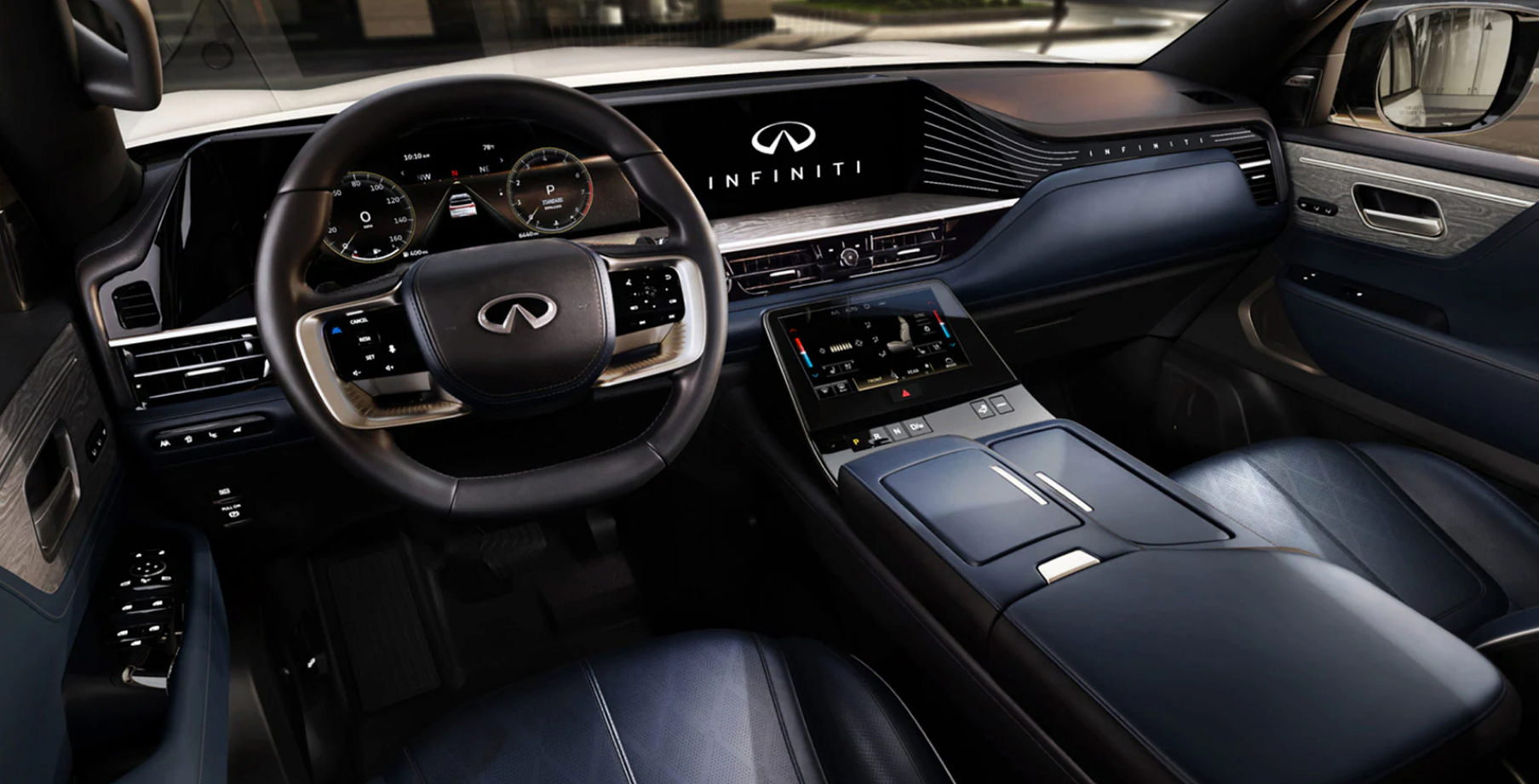
Twin 14.3-inch displays with Google built-in, wireless smartphone integration, and an available 24-speaker Klipsch Reference Premiere audio system anchor the 2026 QX80's technology suite
Technology and Infotainment Systems
Both SUVs run large, high-resolution displays and deep driver-assistance suites. The difference is philosophical: INFINITI built the QX80's system on a familiar consumer platform so it feels immediately intuitive, while BMW built iDrive into an ecosystem that rewards the time you invest learning it.
INFINITI QX80 Technology Features
Infotainment System
The QX80 pairs a 14.3-inch digital instrument cluster with a 14.3-inch central touchscreen, plus a separate touch-capacitive panel for climate that keeps temperature and seat functions off the main screen. Google built-in is the headline feature: Google Maps runs natively with live traffic and EV-style route planning, Google Assistant handles voice commands conversationally, and apps download through Google Play without tethering a phone. Wireless Apple CarPlay and Android Auto are standard and connect automatically. The available Klipsch Reference Premiere audio system runs 24 speakers including headrest-mounted drivers that enable Individual Audio Zones — the driver can take a call while rear passengers keep listening. A 9-inch head-up display, wireless charging, and multiple USB-C ports across all three rows round out the package.
Driver Assistance Features
ProPILOT Assist 2.1 combines adaptive cruise, lane centering, and navigation-linked speed and curve adjustment, supporting hands-off driving on compatible mapped highways — a genuinely fatigue-reducing feature on the I-10 run to Tucson. It's supported by Predictive Forward Collision Warning, Intelligent Forward Collision Warning with automatic emergency braking and pedestrian detection, Blind Spot Intervention, Rear Automatic Braking, and Intelligent Rear View Mirror. The 3D Around View Monitor adds Invisible Hood View, which renders the terrain beneath the front of the vehicle — useful for curbs, parking blocks, and unpaved trailheads.
BMW X7 Technology Features
Infotainment System
The X7 uses BMW's curved display, combining a 12.3-inch instrument cluster and 14.9-inch touchscreen under a single pane of glass angled toward the driver. Control comes via touch, natural-language voice, or the iDrive rotary controller, which remains the best physical interface in the segment for menu navigation at speed. BMW Maps is cloud-based with live rerouting, and over-the-air updates arrive regularly. Wireless Apple CarPlay and Android Auto are standard. The optional Bowers & Wilkins Diamond Surround Sound System — 20 speakers, roughly 1,500 watts, diamond-dome tweeters — is arguably the finest factory audio available at any price, and the available rear-seat entertainment system adds twin 12.3-inch displays with HDMI and streaming.
Driver Assistance Features
Driving Assistant Professional bundles active cruise with stop-and-go, lane-keeping, evasion aid, and front cross-traffic alert. Available Highway Assistant enables hands-free driving on mapped divided highways with a driver-attention camera, and includes an active lane-change function triggered by looking at the mirror. Parking Assistant Professional can execute parking maneuvers from outside the vehicle via smartphone and reverse the last 50 meters of your path automatically — a party trick that turns genuinely useful in tight underground garages.
| Technology Feature | INFINITI QX80 | BMW X7 |
|---|---|---|
| Display Configuration | Dual 14.3-inch screens + climate panel | Curved display: 12.3-inch + 14.9-inch |
| Native Navigation Platform | Google built-in with Google Maps | BMW Maps (cloud-based) |
| Wireless CarPlay & Android Auto | Standard | Standard |
| Premium Audio | Klipsch Reference Premiere, 24 speakers | Bowers & Wilkins Diamond, 20 speakers |
| Hands-Free Highway Driving | ProPILOT Assist 2.1 | Highway Assistant (available) |
| Camera Systems | 3D Around View Monitor with Invisible Hood View | Parking Assistant Professional with remote 3D view |
| Rear-Seat Entertainment | Available dual rear displays | Available dual 12.3-inch displays |
Both are excellent. The QX80's advantage is the learning curve — Google built-in means most drivers are fluent within a day, and the 24-speaker Klipsch system with individual audio zones is a feature the X7 has no direct answer for. BMW's advantage is depth and polish: iDrive's rotary controller, the quality of the Highway Assistant implementation, and the Bowers & Wilkins system's outright fidelity reward owners who care about those details.
Safety Ratings and Features
In a segment this expensive, active-safety hardware is largely a given. Independent crash-test results are not — and this is the one comparison category where the gap between these two SUVs is documented rather than debatable.
INFINITI QX80 Safety Credentials
The 2026 INFINITI QX80 is an Insurance Institute for Highway Safety TOP SAFETY PICK. It earned "Good" ratings — the highest available — in the small overlap front, updated moderate overlap front, and updated side-impact crash tests, along with "Good" ratings for headlight performance, vehicle-to-pedestrian front crash prevention with both the standard and optional systems, and seat belt reminders. That is a clean sweep across every category IIHS evaluated. Standard driver-assistance content is equally comprehensive: automatic emergency braking with pedestrian detection, Predictive Forward Collision Warning that monitors two vehicles ahead, Blind Spot Warning with Blind Spot Intervention, Rear Cross Traffic Alert, Rear Automatic Braking, and Lane Departure Warning. The high, upright seating position and thin A-pillars also deliver the kind of outward visibility that prevents incidents before any system has to intervene.
BMW X7 Safety Credentials
The BMW X7 carries a strong safety feature set — frontal collision warning with city collision mitigation, active blind spot detection, lane departure warning, front and rear cross-traffic alert, and BMW's Active Protection system, which tensions belts and closes windows when it detects an imminent impact. Structurally, BMW uses high-strength steel and aluminum extensively, and the X7's mass works in occupants' favor in multi-vehicle collisions. The important caveat for shoppers is that neither IIHS nor NHTSA has published crash-test ratings for the X7 — low-volume, high-price models frequently go untested — so there is no independent crashworthiness data to compare against the QX80's results.
Comparative Safety Analysis
On features, these two are closely matched, with each offering hands-free highway assistance, comprehensive collision avoidance, and 360-degree camera coverage. On verified performance, the QX80 has something the X7 does not: a current-year IIHS award backed by "Good" scores in every test conducted. For buyers who want third-party validation rather than a spec-sheet promise — and for parents putting children in the second and third rows — that distinction carries real weight. We're happy to walk through the QX80's full safety suite in person, and our INFINITI service center in Mesa keeps those systems calibrated correctly after windshield replacements and alignments, which matters more than most owners realize.
INFINITI QX80 vs BMW X7: Price and Value Comparison
Base MSRPs on these two are closer than most shoppers expect. The separation happens in what each price includes, and in what the SUV costs you every year afterward. If you're still weighing how to structure the transaction, our buy vs. lease guide breaks down which approach fits which ownership timeline.
QX80 Cost Breakdown
The QX80 opens around $89,000 for the PURE, which arrives with the full 450-horsepower engine, the dual 14.3-inch displays with Google built-in, tri-zone climate, a power-folding third row, and the complete standard driver-assistance suite. LUXE (roughly $96,100) adds captain's chairs, ventilated seating, and upgraded materials; SPORT (roughly $104,100) brings blacked-out exterior trim and Dynamic Digital Suspension; AUTOGRAPH (roughly $113,700) is the fully loaded flagship with semi-aniline leather, massage seating, biometric cooling, the 24-speaker Klipsch system, and air suspension. Critically, INFINITI packages content by trim rather than as a long options list — the AUTOGRAPH is essentially complete as delivered.
BMW X7 Pricing Strategy
The X7 xDrive40i starts around $87,500 and the M60i around $115,000 — but those are entry points, not typical transaction prices. BMW's model has always been extensive personalization, and the packages that make an X7 feel like a $100,000 vehicle are extra: Premium and Executive packages, the Bowers & Wilkins audio system, Integral Active Steering, rear-seat entertainment, ventilated and massaging front seats, and individual Merino leather. It is straightforward to configure an xDrive40i past $100,000 and an M60i past $130,000. Compare an equivalently equipped pair and the QX80 typically lands several thousand dollars ahead — while still offering more power than the six-cylinder X7, more towing, and more space.
Analyzing Overall Value
The ownership math extends well past the purchase agreement. Here is how the two compare on the recurring costs that determine what a flagship SUV actually costs to live with:
| Cost Factor | INFINITI QX80 | BMW X7 |
|---|---|---|
| Starting MSRP (2026) | Approximately $89,000 (PURE) | Approximately $87,500 (xDrive40i) |
| Top Trim MSRP | Approximately $113,700 (AUTOGRAPH) | Approximately $115,000 (M60i) |
| Estimated Annual Fuel Cost | $3,000–$3,400 (15,000 miles, premium) | $2,400–$3,200 (varies by engine) |
| Average Annual Insurance | $2,000–$2,500 | $2,300–$2,900 |
| Estimated Annual Maintenance | $900–$1,300 | $1,300–$1,900 |
Warranty coverage separates them further. INFINITI provides 4 years/60,000 miles of basic coverage plus 6 years/70,000 miles of powertrain protection; BMW covers the X7 for 4 years/50,000 miles on both. That extra two years and 20,000 miles of powertrain coverage arrives precisely when turbocharger, transmission, and drivetrain repairs on a heavy luxury SUV become expensive. Routine service costs less on the QX80 as well — BMW specifies particular synthetic oils and procedures, and replacement components for the X7 commonly run 20 to 40 percent above INFINITI equivalents. Depreciation is the one column where the X7 typically holds a modest edge in percentage terms, though the QX80's stronger standard-content-per-dollar and lower running costs generally close that gap in absolute dollars. Shoppers focused purely on value should also look at lightly used examples — our used INFINITI QX80 inventory in Mesa often includes low-mileage units with warranty remaining.
Experience the INFINITI QX80 at Coulter INFINITI in Mesa
Specification tables can tell you that the QX80 holds 22.0 cubic feet behind its third row. They cannot tell you how it feels to fold that row flat with one hand while holding a toddler, or whether your longest passenger actually fits back there. That's a showroom question, and we'd rather you answer it before you sign anything.
Coulter INFINITI is located at 6225 East Test Drive, Mesa, AZ 85206, minutes from the US-60 and convenient to Gilbert, Chandler, Queen Creek, Tempe, Scottsdale, and Gold Canyon. We stock a range of QX80 trims so you can sit in a PURE and an AUTOGRAPH back to back and decide for yourself whether the upgrade is worth it for how you drive.
Straight Answers, No Pressure
If the X7 is the better fit for your situation, we'll tell you. Our job is to help you decide correctly, not to talk you out of a comparison
Towing and Payload Guidance
Bring your trailer specs and we'll walk through hitch configuration, payload math, and which QX80 trim gets you the setup you actually need
Full Ownership Support
Financing specialists, a factory-certified service department, and a genuine INFINITI parts counter — everything the vehicle needs long after delivery day
A test drive answers questions no article can. You'll feel how the twin-turbo V6 pulls from a rolling start onto the freeway, hear how quiet the third row stays at 75 mph, watch the air suspension drop the body when you shut it off, and find out in ninety seconds whether Google built-in works the way your phone does. Bring the whole family — car seats, gear, and all. That's the only load test that counts.
Call (480) 351-7825 to schedule a personalized QX80 test drive, ask about current incentives, or arrange a back-to-back comparison against another SUV you're considering. Our team knows this segment well and will give you an honest read on where the QX80 wins and where it doesn't.
Conclusion
The INFINITI QX80 and BMW X7 are both excellent full-size luxury SUVs, and choosing between them is less about which is better than about which was built for your life.
Choose the BMW X7 if driving dynamics sit at the top of your list. It steers with a precision no body-on-frame SUV can match, its xDrive40i is the more efficient daily driver by a wide margin, the M60i is genuinely fast, and the interior materials are among the finest in the industry. If you rarely fill all three rows, rarely tow, and want an SUV that drives like a large sport sedan, the X7 rewards that priority — provided you're comfortable with the option pricing and the higher long-term service costs.
Choose the INFINITI QX80 if the vehicle needs to do the full job. It brings 450 standard horsepower and 516 lb-ft, an 8,500-pound tow rating, seating for up to eight, nearly twice the cargo room behind the third row, a 2026 IIHS TOP SAFETY PICK award with "Good" ratings across the board, and a powertrain warranty two years longer than BMW's — typically at a lower comparably-equipped price. For most Greater Phoenix families, that combination is simply the more complete answer. Visit Coulter INFINITI at 6225 East Test Drive in Mesa, or call us to line up a drive and see whether the numbers match the feeling.
Visit Coulter INFINITI in Mesa to Find Your QX80
The best comparison happens from the driver's seat. Our team at Coulter INFINITI in Mesa, Arizona can set up back-to-back drives, load your car seats into the third row, run real payment scenarios, and answer every question about trims, towing, and ownership costs — at your pace.
We serve buyers across Mesa, Gilbert, Chandler, Queen Creek, Tempe, Scottsdale, Gold Canyon, and San Tan Valley, and we're glad to help whether you're ready to buy this week or still six months out from a decision.
Call (480) 351-7825 or stop by 6225 East Test Drive, Mesa, AZ 85206. We'll have a QX80 warmed up and ready.